Would You Like to be a Citizen Scientist?
 For
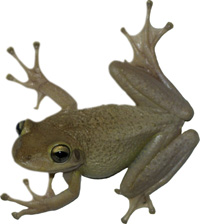
many years, concerned Floridians have been reporting Cuban Treefrog
sightings to Dr. Steve Johnson at the University of Florida, and many
are now euthanizing these invasive treefrogs. Cuban
Treefrogs are common in suburban Florida, where they have
become a huge nuisance to humans and are having harmful impacts on our
native treefrog species. As a result, more Floridians are
now becoming informed and taking action to help manage these frogs in
their neighborhoods. We believe that these efforts can make a
difference by helping to reduce Cuban Treefrog populations and slow
their spread into new areas. Removing Cuban Treefrogs may also help
native treefrogs to survive in suburban areas -- some people report that they have seen
native treefrogs after they started to capture and humanely euthanize
the invaders. We are asking these Floridians who are already removing
and euthanizing Cuban treefrogs to participate in a Citizen Scientist
project by taking the time to report their efforts.
For
many years, concerned Floridians have been reporting Cuban Treefrog
sightings to Dr. Steve Johnson at the University of Florida, and many
are now euthanizing these invasive treefrogs. Cuban
Treefrogs are common in suburban Florida, where they have
become a huge nuisance to humans and are having harmful impacts on our
native treefrog species. As a result, more Floridians are
now becoming informed and taking action to help manage these frogs in
their neighborhoods. We believe that these efforts can make a
difference by helping to reduce Cuban Treefrog populations and slow
their spread into new areas. Removing Cuban Treefrogs may also help
native treefrogs to survive in suburban areas -- some people report that they have seen
native treefrogs after they started to capture and humanely euthanize
the invaders. We are asking these Floridians who are already removing
and euthanizing Cuban treefrogs to participate in a Citizen Scientist
project by taking the time to report their efforts.
Note: We do not advocate the needless or inhumane killing of wildlife. Unfortunately, these invasive frogs are having serious negative impacts on our native species and do need to be managed. If you are unsure of the identity of a frog, please email us photos for identification BEFORE euthanizing the frog. Be sure to always euthanize frogs humanely, as described below.
Citizen scientists can help by telling us:
How many Cuban
Treefrogs have you captured and euthanized?
When
and where did you catch them?
How big were they?
Have you seen any native treefrogs?
Participating can be as simple as taking photos of the frogs you euthanize and sending them in with your data sheet (a list of how many frogs you catch). However, if you are not 100% sure of a frog's identity, do not euthanize it -- Email us photos for help with identification!
Keep reading for step by step instructions on how to report your efforts to manage Cuban Treefrogs. Your reports can help us to learn more about the effectiveness of citizens' efforts to manage these invasive frogs in urbanized areas.
 You
will need the free Adobe Reader to view the PDF files.
You
will need the free Adobe Reader to view the PDF files.
1. Catching Treefrogs (Back to Index)
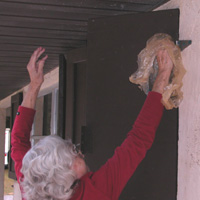
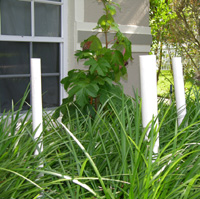
Treefrogs can be easily captured by hand -- however, you should use a plastic bag to cover your hand when catching Cuban Treefrogs, as shown in the image on the left below. Cuban Treefrogs secrete a noxious slime that can temporarily irritate your eyes and nose, so be careful! You can also use PVC treefrog houses to attract and capture even more treefrogs. Read the fact sheets below for more information.
- The Cuban Treefrog in Florida - fact sheet
- How to Make a Treefrog House - fact sheet for kids
2. Identifying Treefrogs (Back to Index)
There are several species of treefrogs that may be found in suburban areas, including invasive Cuban treefrogs and native Green, Squirrel, Barking, and Pinewoods Treefrogs. For tips on how to identify these species, visit our treefrog photo gallery pages and read the handout below. If you are not 100% sure of a frog's identity, do not euthanize it -- Email us photos for help with identification!
- Treefrog Photo Galleries
- Florida Invader: Cuban Treefrog (710KB pdf) - identification handout
3. Euthanizing Treefrogs (Back to Index)
Cuban Treefrogs are pests, but they are living animals and should always be treated humanely. We recommend a two-part method to humanely euthanize these frogs and ensure that the method was successful. Remember -- if you are not 100% sure of a frog's identity, do not euthanize it -- Email us photos for help with identification!
- BENZOCAINE - Purchase toothache gel or sunburn or first aid spray containing 20% benzocaine from your local drugstore. Sprays containing 5% lidocaine will also work, but may work a bit more slowly and require a lot more spray. Liberally rub or spray the frog (while it is in a bag, preferably) with the benzocaine. Try not to get the benzocaine in the frog's eyes, as it may cause pain. The frog will become comatose within about a minute, and will soon be euthanized.
- FREEZING - We recommend that you place the treated frog into the freezer for 24 hours to make sure that it is euthanized and will not wake up later in a plastic bag in the garbage. If the frog is not already comatose, it will simply go into a hibernation-like state and never wake up. The benzocaine will ensure that the frog does not feel any pain from freezing.
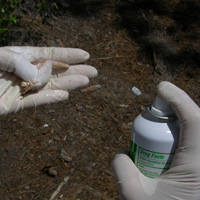
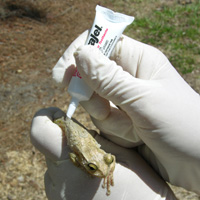
Note: If you prefer not to euthanize these frogs, you can still participate by removing these frogs from the native environment and caring for them as pets. However, it is important to realize that you cannot release these frogs after you capture them -- doing so is illegal and ecologically irresponsible!
4. Collecting Data
Before you begin collecting data, you will need to print the Cuban Treefrog Citizen Science data sheet. Click here to view and print the data sheet (27 KB pdf). Fill out the top of the data sheet with some information about yourself -- your name, complete address of the location where you caught the frogs, and your email address. If you catch frogs at several locations (e.g., home and work), please use a separate data sheet for each location.
Data to collect for each frog you observe:
- PHOTOS - photos are important, since they prove that the
frog euthanized WAS a Cuban Treefrog. Remember -- if you are not
100% sure of a frog's identity, do not euthanize it --
Email us photos for help with identification! Give each digital photo file a unique name -- you
might want to include your name, the frog's
number on the data sheet, and the capture date (For example,
you might name the file "Johnson_Frog1_1Jan2010.jpg").
- Try to take a picture of the frog where you found it (on the wall, in a plant, etc.) - just in case it escapes before you catch it. Remember -- if you are not 100% sure of a frog's identity, email us photos for help with identification!
- After you capture the frog, take another photo of the frog next to something we can use for a size reference -- a ruler is best.
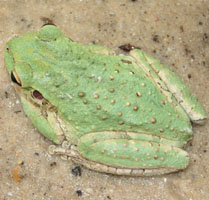
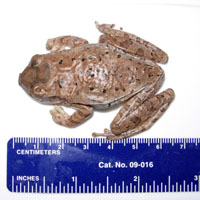
- DATE - write the date the frog was captured,
including the full year to avoid confusion
(For example, write 2010, not 10) - HOW AND WHERE - provide some information about the location where the frog was found and captured. (For example - "hand caught under porch light" or "PVC by house"). If you observed a frog, but weren't able to catch it, you can make a note here. If you see a native treefrog and would rather not catch it, just make a note of your observation here, and try to photograph the frog so we can identify it.
- FROG SPECIES - Report the common name for any treefrog you capture or observe. You do not necessarily need to capture and measure native treefrogs, but we would like to hear about these observations. You should also indicate the final disposition of the frog -- native species should be released, and Cuban Treefrogs should be permanently removed from the native environment. If you prefer not to euthanize these frogs, then you may choose to care for them as pets and should note this on your data sheet. It is important to realize that you cannot release these frogs after you capture them -- doing so is illegal and ecologically irresponsible! Remember -- if you are not 100% sure of a frog's identity, email us photos for help with identification!
- FROG SIZE - It would be very helpful to know what size frogs you are removing, since this information can tell us a lot about the ecology of these frogs. After you catch a Cuban Treefrog, you can measure it while it is still in a clear plastic bag (this may be easier after you apply benzocaine). Place the frog onto a ruler, and line its nose up with the zero mark. Press gently on the middle of the frog's back to flatten the "hinge" between the frog's spine and pelvis. Record the frog's length (millimeters is best) as the point marked by the tip of the rear end.
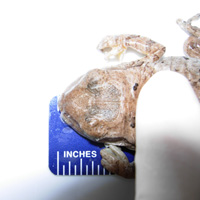
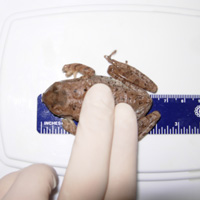
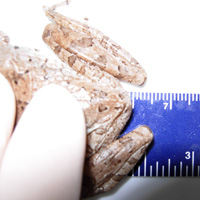
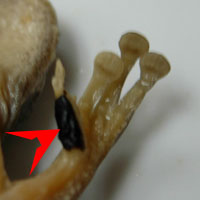
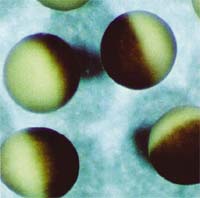
- FROG SEX - After you are comfortable catching, measuring, and euthanizing the frogs, you might also decide to check the frog for external tell-tale signs that will tell you if it is male or female. You are most likely to see these signs during the summer breeding season. You can check the thumbs for "nuptial pads" - males have dark calluses that they use to grip females during mating -- indicated by the red arrow in the photo at left below. You can also check for eggs (females) by looking closely at the groin area where the leg meets the lower belly -- can you see eggs through the body wall? The eggs are small (BB-sized), and look half black/half white - like the eggs shown in the photo on the left. Make notes on your data sheet if you see nuptial pads or eggs, and take photos of these characteristics if possible.
5. Reporting Data (Back to Index)
Report your data at least once per quarter (every 3 months), even if your data sheet isn't full.
- EMAIL - Email your data sheet and photos to Dr. Johnson at tadpole@ufl.edu
- SNAIL MAIL - Mail your data sheet and photos to
ATTN: Dr. Steve A. Johnson
University of Florida/IFAS
Dept. of Wildlife Ecology & Conservation
110 Newins-Ziegler Hall, PO Box 110430
Gainesville, FL 32611
More About Cuban Treefrogs (Back to Index)
To learn more about Cuban Treefrogs, read the fact sheet below, and follow the links listed under research in the index on the left side of the page.
- The Cuban Treefrog in Florida - fact sheet